SaaS Replacement

Replace one piece of software. Keep the work moving.

Keep the work, data, logins, and connections that matter, test a way back, and switch over only when you say so.

[digital project]
the problem

The subscription never ends. Neither does the bill.

The same charge comes out every month. Each renewal it's a little higher, and every new person, tier, or add-on raises it again. Add it up over a few years and it's real money, and you still don't own any of it: not the setup, not your data's format, not a way out.

Replacing it can lower what you pay over time, but only if the work, the records, and the connections come with you. This starts by checking whether leaving actually pays. If it doesn't, or there's no safe way out, I'll tell you before anything is picked or built.
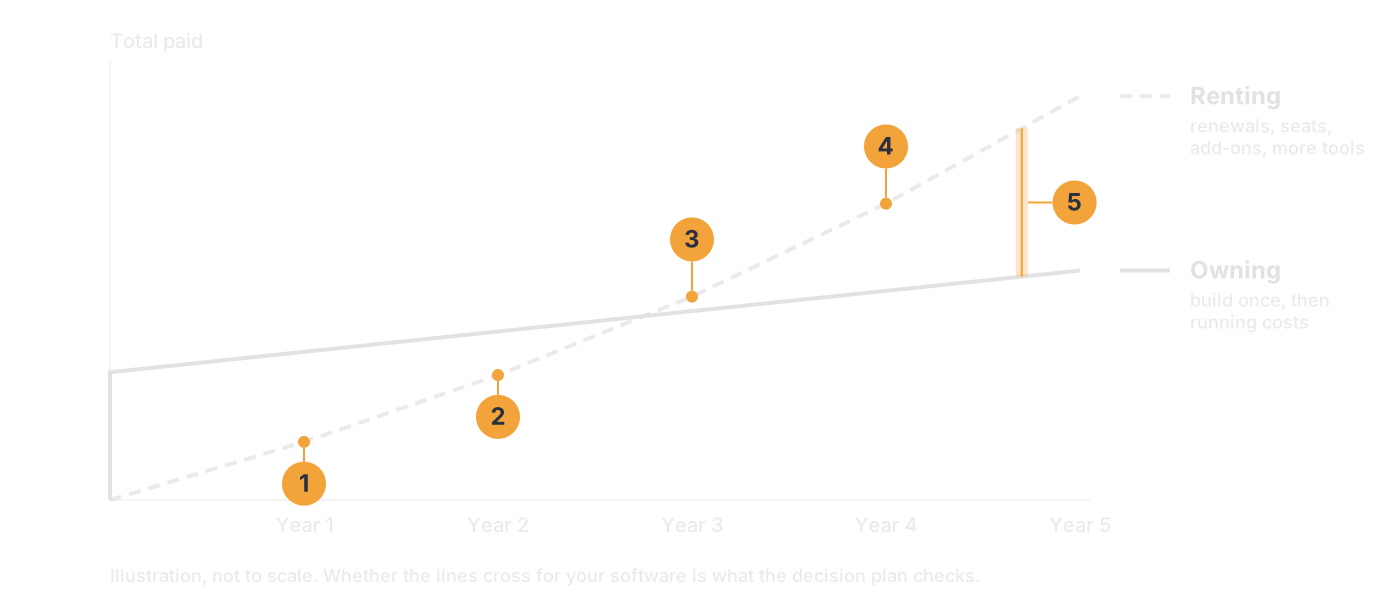
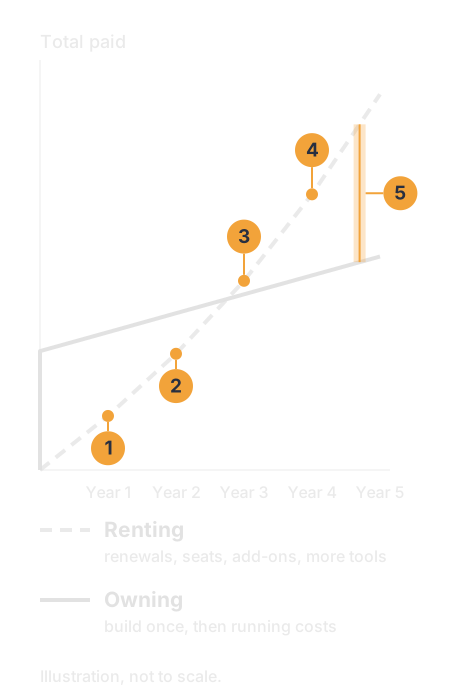
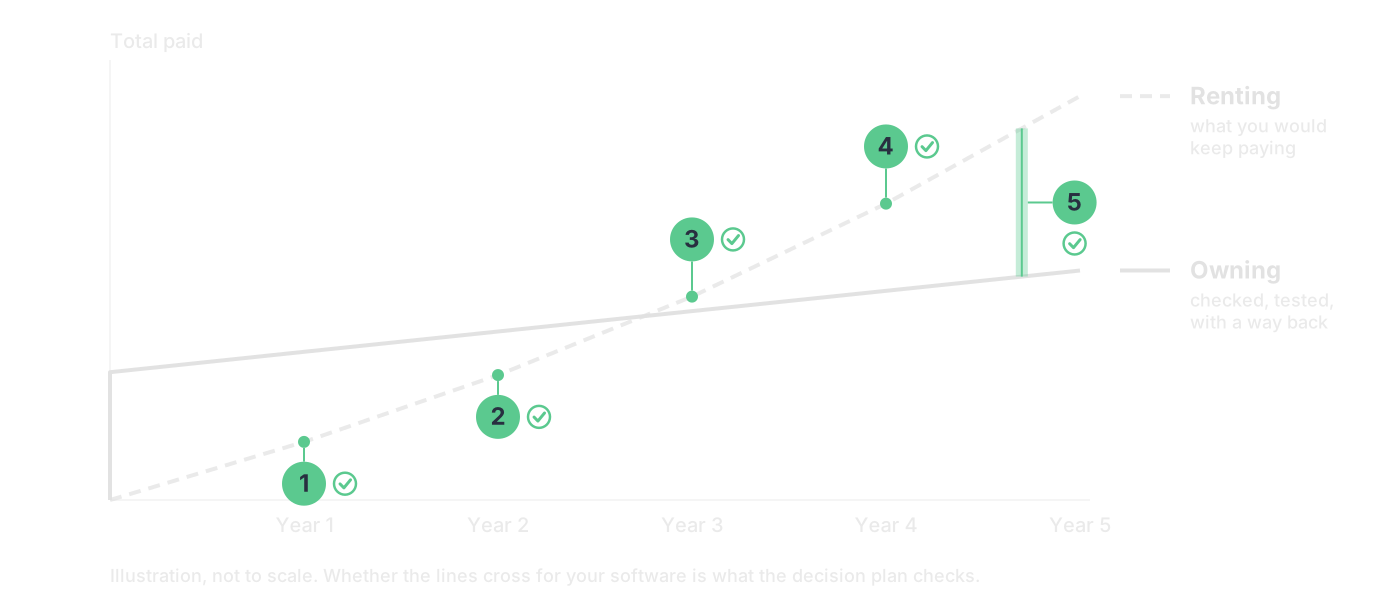
An illustration of what you pay over time, not to scale. Renting software starts low and gets steeper every year as renewals, seats, add-ons, and more tools pile up. Owning the replacement starts higher with a one-time build, then rises slowly with running costs. The lines cross, and the gap after that is the saving. Five numbered break points: 1 the bill goes up, 2 subscriptions stack up, 3 your data grows inside their system, 4 leaving looks harder each year, 5 the saving only shows up once the old bill stops.The same illustration, not to scale: renting gets steeper every year, owning starts higher and rises slowly, and the lines cross. Five numbered break points: 1 the bill goes up, 2 subscriptions stack up, 3 your data grows inside their system, 4 leaving looks harder each year, 5 the saving only shows up once the old bill stops.
Break point 1
Break point 1 · The bill

The bill only goes up

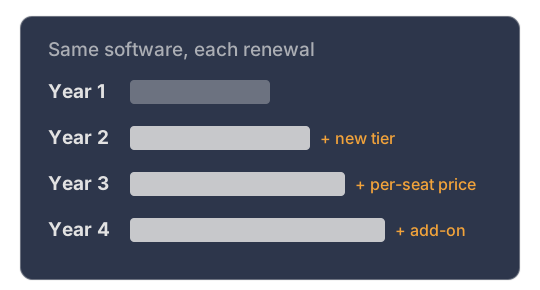
It started as one reasonable monthly fee. Then the renewal came in higher. Then you had to move up a tier, pay for each new person, and buy an add-on for something you thought was included. None of it is big on its own. Over a few years it adds up, and some of it pays for features you never use.
[digital project]
Break point 2
Break point 2 · The stack

The subscriptions pile up

One app for scheduling, one for invoicing, one for forms, one for texting, and a few more connected to your accounting. Each one has its own login, its own bill, and its own renewal date. Some overlap. Some nobody has opened in months. And someone on your team still re-enters information between them to keep it all lined up.
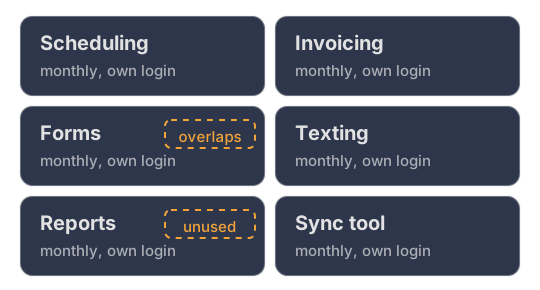
image of sustainable product implementation [digital project]
Break point 3
Break point 3 · Your data

Your data lives on their terms

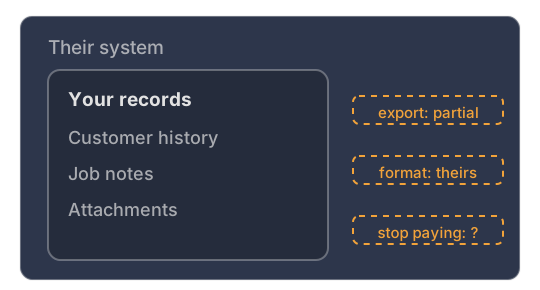
Your customer list, job history, and records belong to your business. But they sit in someone else's system, in their format, behind their login. The longer you stay, the more of your history lives there. What the export actually includes, and what happens to your records if you stop paying, is set by their terms, not yours.
[digital project]
Break point 4
Break point 4 · The exit

Leaving looks like more work than the bill

You'd switch if it were easy. But moving the data, retraining the team, and not knowing what will break all feel bigger than one more year of the bill. The contract may not let you out early anyway. So you renew again, and the price goes up again.
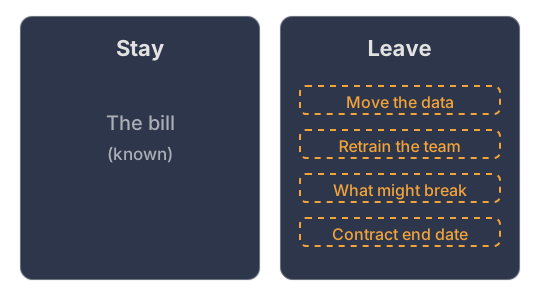
image of sustainable product implementation [digital project]
Break point 5
Break point 5 · The savings

The savings never show up

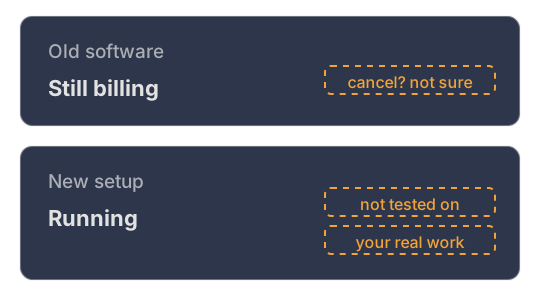
Savings only start when the old bill stops. If the new setup was never tested on your real work, nobody trusts it enough to cancel, so you pay for both. Or the old one gets cancelled too soon, and fixing the gaps costs more than the subscription did. The saving is real only when the work runs and the old charge is gone.
[digital project]
the solution

Own the setup. Then decide if the bill goes.

SaaS Replacement moves one piece of rented software into a setup you control, but only after a paid decision plan shows that leaving pays and there's a safe way back. Your data is moved and checked, the work is tested, and canceling the old subscription stays your call.
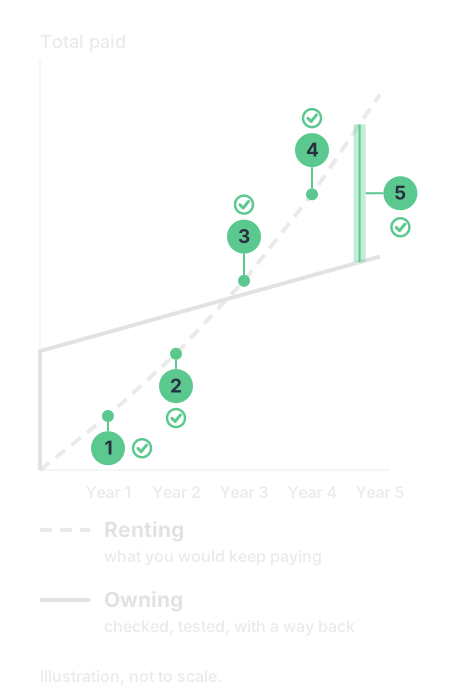
The same cost picture, an illustration not to scale: renting starts low and gets steeper each year, owning starts higher with a one-time build then rises slowly. Points 1 to 5 are each marked handled, and the gap after the lines cross is the saving.The same cost picture, not to scale, with points 1 to 5 each marked handled.
Solution 1
Solution 1 · The bill

Find out if leaving pays, first

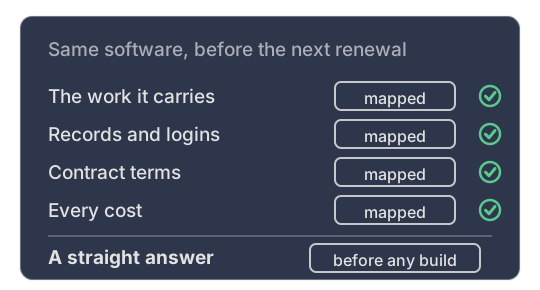
A paid decision plan maps what the software actually carries: the work, records, logins, connections, contract terms, and every cost. Then you get a straight answer: replace it, keep it, set it up differently, or renegotiate. If leaving doesn't pay, you hear that before anything is built.
[digital project]
Solution 2
Solution 2 · The stack

The smallest setup that does the job

Use what you already own where it works, or add the smallest replacement that covers the overlap. Products, automation, custom code, and AI get picked only after the needs are clear, so you don't trade one pile of subscriptions for another.
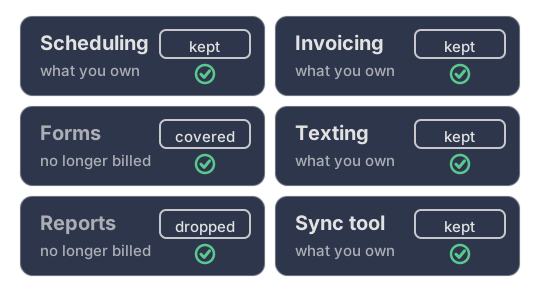
image of sustainable product implementation [digital project]
Solution 3
Your records come with you, checked

Your records come with you, checked

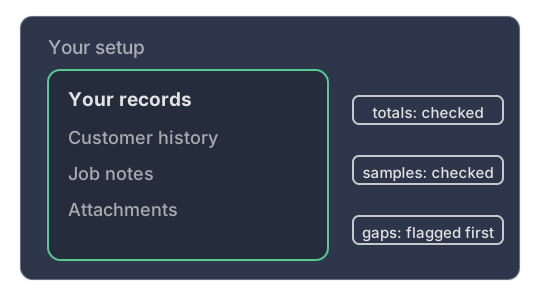
The agreed records move over with the history you need, and totals and samples are checked against the old system. Anything that can't be exported is flagged before the switch, not after.
[digital project]
Solution 4
Solution 4 · The exit

A way out, and a way back

Before the switch, you know what replaces it, what stays, who controls each account, how it gets tested, and how you get back to safety if something fails. Leaving stops being a leap.
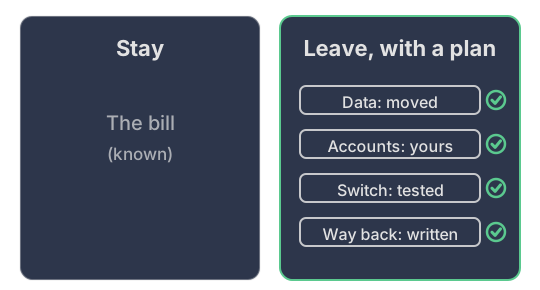
image of sustainable product implementation [digital project]
Solution 5
Solution 5 · The savings

Tested on your real work, then your call

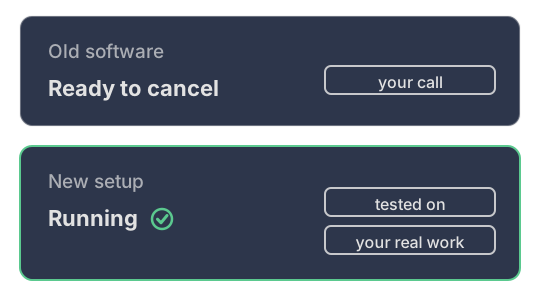
The work, logins, connections, odd cases, and the way back are tested, side by side with the old system when the risk calls for it. You approve the switch, get the instructions, and the old subscription stays ready for you to cancel. That's when the saving can start.
[digital project]

How it works

What happens, and when you pay.

Every step, and what gets paid at each one.

Included

What you get.

Receipt under a magnifying glass

Decide first

Find out what the software really does for you, and whether replacing it is worth it, before anything is built.
what you get
  • Every job, record, login, and connection the software carries, written down
  • The contract terms, the renewal date, and what it really costs you with add-ons and seats
  • A written go or no-go you keep, even if the answer is to keep what you have
why it matters
  • The price on the plan is rarely the whole bill once the add-ons and extra seats pile up
  • You decide on the facts, not on how tired you are of the invoice
  • If switching isn't worth it, you learn that for the price of a plan, not a failed project
A path forward with a marked way back

Plan the new setup and a way back

Agree on what replaces it, what stays, and how you get back if the switch goes wrong.
what you get
  • What replaces each job, and what stays the way it is
  • Who holds each account and login
  • A way back to the old setup, checked before anything changes
why it matters
  • Leaving stops looking like more hassle than the bill
  • Every account is in your name, so no vendor holds the keys to your business
  • You know the way out before you commit to the way in
Two blocks with one new block on top

Set up or build

Use what you already pay for where it works, and add only the smallest piece that does the job.
what you get
  • Tools you already own checked first
  • The smallest replacement that covers the work, picked after the needs are clear
  • Settings and any custom pieces written down
why it matters
  • Trading one bloated tool for another fixes nothing
  • Fewer apps touching your books, not more
  • You stop paying for features nobody opens
Records moving from one store to another, checked

Move and check the data

Move the records you need, and prove they arrived.
what you get
  • The agreed records and history moved
  • Totals and samples checked against the old system
  • Anything that can't be exported, flagged before the switch
why it matters
  • You don't have to take a vendor's word that your data came across
  • Your customer history, jobs, and invoices stay yours
  • Surprises show up before the switch, not after it
Old and new side by side, both checked

Test the work

Run your real work through the new setup before you depend on it.
what you get
  • Real jobs, logins, and connections tested
  • Odd cases and failure alerts checked
  • Old and new run side by side when the risk calls for it
why it matters
  • A cheaper tool gets expensive fast if your staff still re-enters customer info
  • Your team isn't the test crew on a busy day
  • Nobody keeps a backup spreadsheet "just in case", because the new way already works
A switch turned on, and a key

Switch over and hand off

Switch on a date you approve, get the keys, and cancel the old subscription when you're ready.
what you get
  • The switch made on a date you approve
  • A short guide to how everything runs
  • Every login handed to you, and the old subscription ready for you to cancel
why it matters
  • The savings only start when the old charge is actually gone
  • You own the setup and the records, not a login to someone else's system
  • Anyone on your team can follow the guide, not only the person who set it up

Straight shooter

What you keep paying after launch.

Every yearly cost, who bills you, and whether you need it. These are estimates. You pay each vendor directly, at their price, with no markup.

The offer

A paid decision plan first. Then one fixed price.

The decision plan tells you whether replacing the software is worth it, what it would take, and how you'd get back if it went wrong. If I do the replacement, its cost is credited in full.

  • One piece of software, replaced by something you control.
  • The replacement is one fixed price, set after the decision plan and before any build starts.
  • Software and hosting costs are listed before you approve, and you pay those providers directly.
  • Every account and all your data are in your name, and you keep all of it.
Decision and Exit Plan

Phoenix
1490
Middle starting price of the monthly local SEO and listings plans published by 5 Phoenix agencies, September 2026.
Atlanta
1000
Too few Atlanta agencies publish a comparable plan (3), so this uses the all-markets figure: the middle starting price of 57 monthly plans published across 15 metros, September 2026.
Austin
1000
Too few Austin agencies publish a comparable plan (3), so this uses the all-markets figure: the middle starting price of 57 monthly plans published across 15 metros, September 2026.
Charlotte
1000
Too few Charlotte agencies publish a comparable plan (3), so this uses the all-markets figure: the middle starting price of 57 monthly plans published across 15 metros, September 2026.
Dallas
500
Middle starting price of the monthly local SEO and listings plans published by 5 Dallas agencies, September 2026.
Denver
1000
Too few Denver agencies publish a comparable plan (4), so this uses the all-markets figure: the middle starting price of 57 monthly plans published across 15 metros, September 2026.
Houston
1000
Too few Houston agencies publish a comparable plan (3), so this uses the all-markets figure: the middle starting price of 57 monthly plans published across 15 metros, September 2026.
Las Vegas
525
Middle starting price of the monthly local SEO and listings plans published by 6 Las Vegas agencies, September 2026.
Los Angeles
1000
Too few Los Angeles agencies publish a comparable plan (3), so this uses the all-markets figure: the middle starting price of 57 monthly plans published across 15 metros, September 2026.
Nashville
1000
Too few Nashville agencies publish a comparable plan (2), so this uses the all-markets figure: the middle starting price of 57 monthly plans published across 15 metros, September 2026.
Orlando
1000
Middle starting price of the monthly local SEO and listings plans published by 5 Orlando agencies, September 2026.
Raleigh
1000
Too few Raleigh agencies publish a comparable plan (0), so this uses the all-markets figure: the middle starting price of 57 monthly plans published across 15 metros, September 2026.
Salt Lake City
1000
Too few Salt Lake City agencies publish a comparable plan (4), so this uses the all-markets figure: the middle starting price of 57 monthly plans published across 15 metros, September 2026.
San Antonio
1000
Too few San Antonio agencies publish a comparable plan (2), so this uses the all-markets figure: the middle starting price of 57 monthly plans published across 15 metros, September 2026.
San Diego
1000
Too few San Diego agencies publish a comparable plan (4), so this uses the all-markets figure: the middle starting price of 57 monthly plans published across 15 metros, September 2026.
Tampa
1500
Middle starting price of the monthly local SEO and listings plans published by 5 Tampa agencies, September 2026.
All other markets
1000
Middle starting price of 57 monthly local SEO and listings plans published across 15 US metros, September 2026.

Modern digital infrastructure

What you get.

Infrastructure for sustained growth

Modular architecture that supports complex projects while remaining maintainable and scalable.

Adaptive systems for teams

Shared components and conventions that accelerate delivery, reduce errors, and preserve consistency.

Tools built to scale

Engineered for complex layouts, continuous evolution, and long-term performance.

Decision and Exit Plan

Engineered for complex layouts, continuous evolution, and long-term performance.

image of data analytics dashboard (for a real estate tech) [interface]
completion

How you know the switch is done.

Your work runs in the replacement you control, the data checks out, the logins and connections pass their tests, and you decide whether to drop the old software.

  • The normal work, the odd cases, failures, and the exit all pass start to finish.
  • Logins and permissions work the way you approved.
  • Connected tools send and receive what they should, including failure alerts.
  • Data totals and spot checks match the old system.
  • Backups, exports, the way back, and access are checked.
  • Every license, usage charge, support duty, and monthly cost is listed.
  • Your team can run the replacement from the instructions you get.
  • Downgrading or canceling the old software stays your call.

Is this the right fit?

Read both columns before you reach out. If the right side sounds like you, something else will serve you better, and I'll say so.

When something else fits better.

A good fit starts with one piece of software and a real reason to leave.

Success depends on zero downtime, zero subscriptions, promised savings, or just a demo.
The payoff is worth the planning, moving, testing, and switchover.
The access, authority, privacy, security, or legal requirements can't be met.
The work and records that have to survive can be listed.
You want to cancel right away, before the data and connections are checked.
You have the authority and admin access to change it.
You want to overhaul all your software, your CRM, or your ERP at once.
The reason is real: cost, control, how you work, or owning your data.
Nobody can name the software or the reason to leave it.
You're seriously considering replacing one specific piece of software.