
Your site can look finished and still be invisible
27
times more search visits a week after the rebuild, before any news (1.2 to 32)

Zone Zero California is a wildfire-safety site I own. For eight months it ran on a site made by an AI website generator. It looked complete. It had about 150 city and county pages. Almost nobody found it.
This is what was wrong, what fixed it, and what the numbers show, including the parts that did not work.
Eight months, almost no visitors
From October 2025 to June 2026, Google showed only 18 of the site's 160 pages in search results. Those pages earned 12 clicks from Google in eight months. Nothing on the screen looked broken. The problem was in what the site sent to a search engine, which you never see.
If you paid for a site and it gets no calls, this is one of the first things worth checking.
What I set out to test
If every page sends its own words to a search engine, the site starts getting found, even before you publish anything new or the topic makes the news.
What a search engine received
18
of 160 pages ever shown in Google, October 2025 to June 2026

Every address on the AI-generated site returned the same file: 4,133 bytes, with no readable words in it. The words only appeared after a script ran in a visitor's browser. Every page also told Google that the real page was the home page.
So when Google asked for the Ventura County page, it got a blank page that pointed somewhere else. After the rebuild, the same address returned its own headline, its own sections, and 585 words.
The fix
Rebuild the site so each page is delivered with its own words, its own title, and its own address, readable without running any script. Keep the topic the same so the result shows what the structure did.
What changed
32
search visits a week after the rebuild, June 29 to August 16, 2026
The rebuild went live on June 29, 2026. Each of the 58 county pages now arrives with its own headline and text. The site also gained pages on the regulations and a free checker for your own address.
One honest limit: the structure and the content changed at the same time, so the numbers credit the rebuild as a whole, not one part of it.
How it was measured
- Visits from search engines and from AI assistants, week by week, from Google Analytics.
- Clicks, impressions, and average position from Google Search Console.
- The raw file each build sent to a search engine, fetched the way a crawler fetches it.
Numbers run from October 2025 to September 23, 2026. September is a partial month.
What happened when the news broke
705
search visits in the week of September 14, 2026

On August 19, the state Board of Forestry approved the Zone 0 draft and the topic hit the news. Search visits jumped to about 540 that week and have held near 700 a week since. The site was readable before the news, so it was ready to be found when people started searching.
In the first 23 days of September, search sent more visits than in all of August. The average Google position went from 45 in June to 5.3.
What lasted, and what did not
2231
visits from AI assistants in their biggest week, August 24, 2026
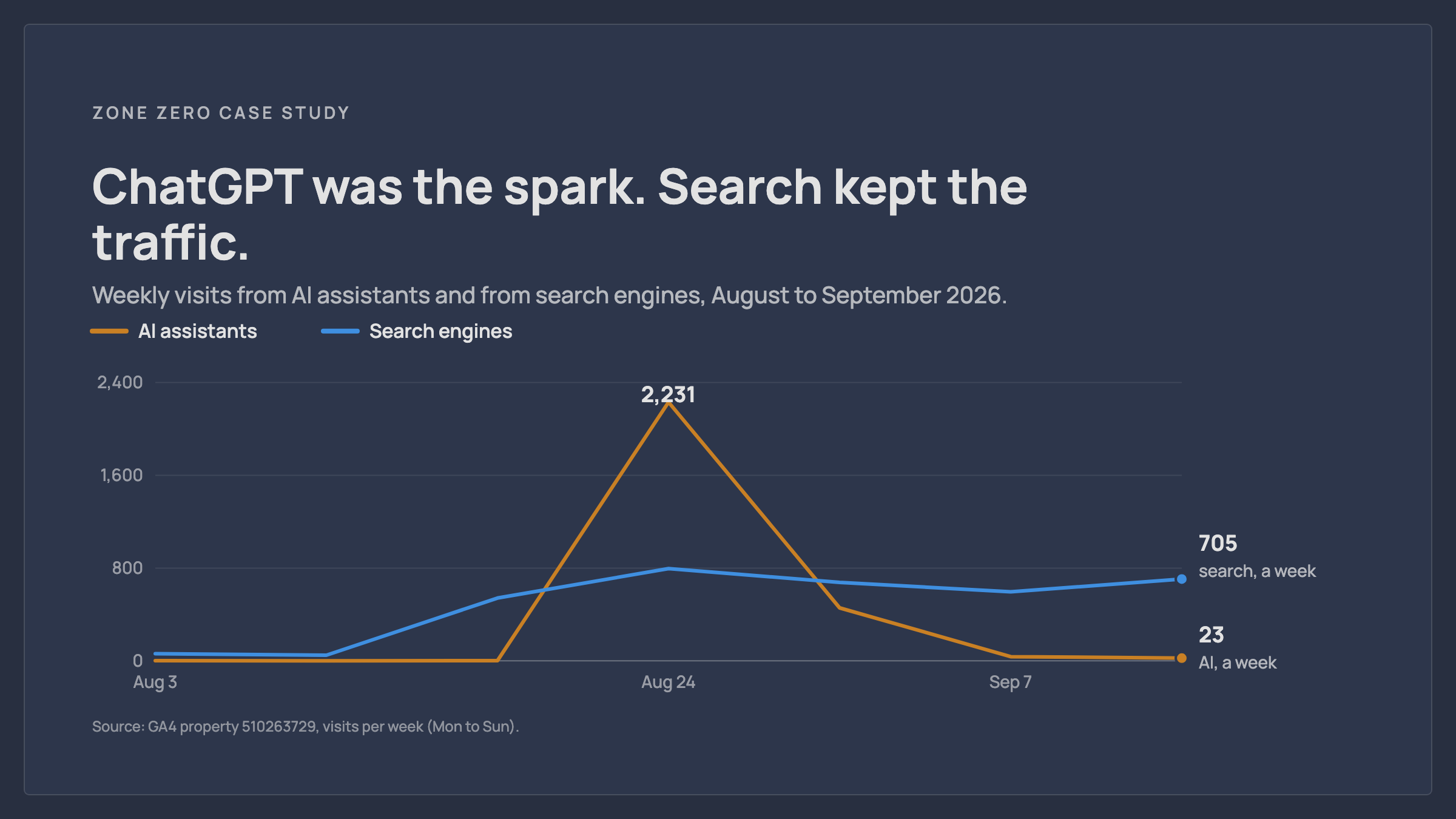
ChatGPT started sending visitors on August 29. In the biggest week, AI assistants sent 2,231 visits, almost all from ChatGPT. By mid-September they sent 23 a week. Search is what lasted.
The weak link is the handoff. The free address checker was completed about 2,280 times in August and September. It produced 5 requests to be contacted. Getting found is not the same as getting a call, and that gap is the next thing to fix.
Limits of this study
- The rebuild changed the structure and the content at once. The data cannot split the credit.
- The Zone 0 news in August is a second cause of the jump after August 19. The before-the-news window (32 a week) is the cleaner test.
- This is one site, and I own it. It shows a mechanism, not that every AI-generated site fails.
- Total visits on August 19 to 21 also include a burst from Facebook. It is not counted in the search line.